Retatrutide usually arrives as a freeze-dried powder that needs to be mixed into a liquid before it can be used in research. This guide walks through what’s known about dosing from published studies, how that mixing (called “reconstitution”) is generally done, how to store it, and mistakes people commonly run into. It’s written to explain the science in plain language — not as instructions for using it on a person or animal.
Dosing in the Research Literature
Since retatrutide is still experimental, any numbers you’ll find about dosing come from clinical trials run under medical supervision — not general-use guidelines. Here’s what’s been published:
- The Phase 2 study (published in the New England Journal of Medicine, 2023) tested a few different weekly doses — roughly 1 mg, 4 mg, 8 mg, and 12 mg — compared to a placebo.
- For the higher doses, people started lower and worked their way up gradually over several weeks. That was mainly to reduce stomach-related side effects, not because it’s a “correct” pattern to copy.
- Later Phase 3 trials have mostly focused on a smaller set of doses, with 12 mg showing up most often as the highest one tested.
- A lot of the published research is specifically looking at how results change across these different doses.
These numbers tell us what’s been tested in supervised clinical trials — they’re not a how-to guide. Any dose used in a lab setting (for cell studies or animal research, for example) should be worked out separately based on that specific study, not copied from human trial numbers.
Reconstitution Step by Step
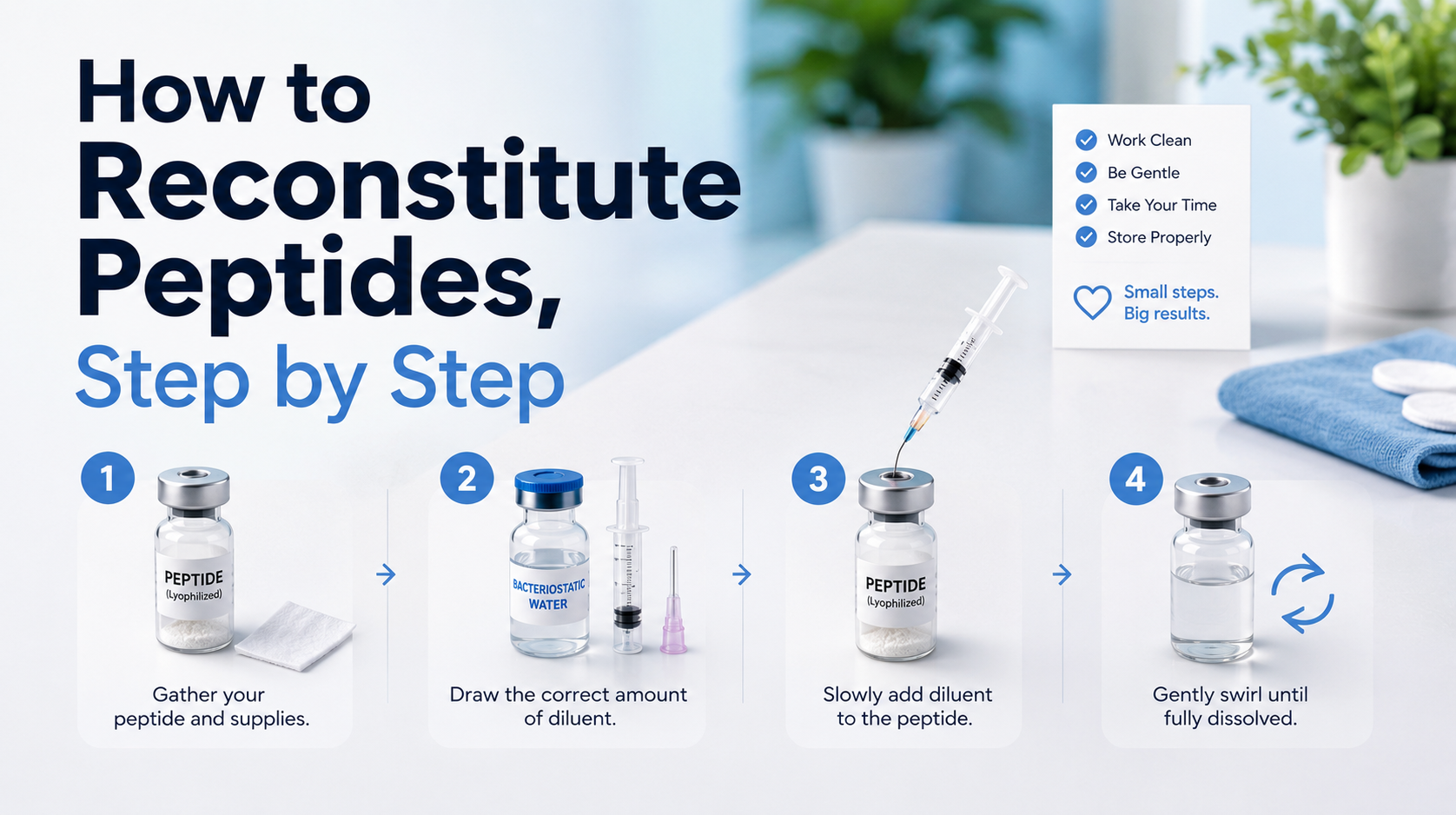
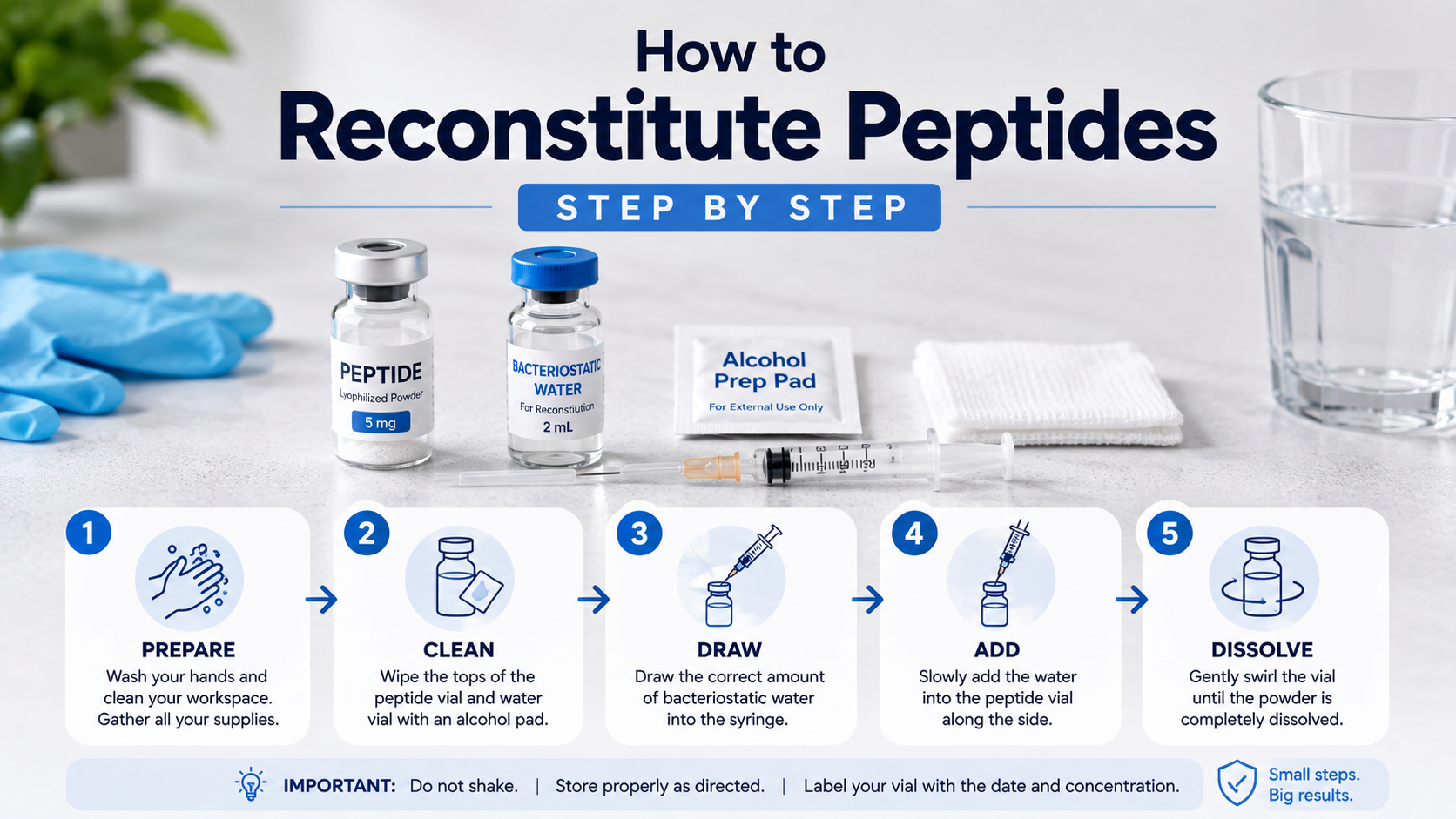
“Reconstitution” just means turning the freeze-dried powder back into a liquid at a known strength, so it can be measured accurately. Here’s generally how that’s done:
- Get your materials together: the vial of retatrutide, bacteriostatic water, alcohol swabs, and a clean syringe.
- Sanitize the vial top and your workspace with an alcohol swab before opening anything.
- Determine your mixing strength: divide the milligrams of peptide by the milliliters of water added. A 10 mg vial with 2 mL of water yields 5 mg per mL; stretching that to 5 mL brings it down to 2 mg per mL.
- Draw up the calculated volume of water, clearing any air from the syringe as you go.
- Introduce the water gradually along the vial wall, avoiding a direct stream onto the powder so it doesn’t foam.
- Dissolve by swirling, not shaking — shaking is rough enough to compromise the peptide.
- Look for a clear solution. Anything cloudy or containing particles should be discarded rather than used.
- Label the vial right away with the date and the concentration you worked out.
- Transfer it to storage immediately, per the guidance below.
Storage and Stability
Before mixing: Keep it frozen, dry, and out of the light until you’re ready to use it. Even if the vial looks fine, sitting out in heat or light can shorten its shelf life.
After mixing: Once it’s in liquid form, it doesn’t last nearly as long. The usual approach is to keep it in the fridge (not the freezer, unless testing shows that’s fine), out of the light, and to use it within a certain window — how long exactly depends on the specific setup.
Avoid freezing and thawing repeatedly: That’s one of the fastest ways to degrade it. If several doses are needed over time, splitting it into smaller portions right after mixing helps avoid this.
Don’t just trust a generic timeline: Shelf-life numbers you see online are a starting point, not a guarantee — they can vary a lot depending on the specific liquid, strength, and storage setup used.
Common Handling Mistakes
- Using the wrong liquid. Tap water or regular saline isn’t the same as sterile bacteriostatic water, and can introduce contamination or affect stability.
- Shaking instead of swirling. This is one of the most common ways people accidentally damage the peptide.
- Squirting the liquid straight onto the powder. This can cause foaming and stress the peptide before it’s even dissolved.
- Leaving it out at room temperature too long. It degrades faster than it looks.
- Freezing and thawing it over and over. Each cycle adds more damage.
- Not labeling vials. It’s easy to lose track of strength and age without clear notes.
- Skipping the certificate of analysis. Always worth checking what’s actually in the batch before using it.
- Treating trial doses as a personal guide. The numbers from clinical trials come from a specific, supervised setup, not a general rulebook.
Research Use Disclaimer
Retatrutide is still an experimental compound — it hasn’t been approved by the FDA or any other health authority for any use, and it isn’t a drug, food, supplement, or cosmetic. Everything in this guide is meant for general educational purposes, based on what’s published in the scientific and clinical trial literature. None of it is medical advice, a treatment plan, or instructions for using retatrutide on a person or animal.
Retatrutide sold by Blueprint Sciences is strictly for research use, not for humans or animals to consume. Every batch comes with a certificate of analysis. You can check out the current listing here: Retatrutide 10mg – Research Use Only.
Using retatrutide outside of a legitimate research setting isn’t something we support or recommend — it just isn’t approved for that yet.