GHK-Cu is typically supplied as a freeze-dried peptide, the same way most research peptides are, and needs to be reconstituted before it can be used in a study. What makes its dosing picture a little different from some other compounds in this series is that GHK-Cu research spans several very different contexts — cell culture, animal models, and finished cosmetic products — that don’t translate cleanly into a single number. This guide covers how dosing shows up across that research, how reconstitution is generally done, how to store it, and a few handling notes — written to explain the science in plain terms, not as instructions for using it on a person or animal.
Dosing in the Literature
GHK-Cu’s dosing story is less about a missing human data point (like some other research peptides) and more about several disconnected data points that don’t add up to one clear standard:
- Cell culture (in vitro) research has found meaningful effects at extremely small concentrations — picomolar to nanomolar range — when applied directly to cultured skin fibroblasts, which speaks to how potent the compound is at the cellular level.
- Animal wound-healing studies have used a range of topical and injected amounts depending on the specific model, species, and delivery method. Because those doses are scaled to a particular study design, they don’t convert directly into a general reference figure.
- Commercial cosmetic formulations use GHK-Cu at low concentrations calibrated for a finished, topical, over-the-counter product — a very different context from dosing the raw peptide for a research protocol.
The takeaway: there’s no single, established human dosing standard for GHK-Cu in its raw, research-grade form. Any specific number circulating online as “the GHK-Cu dose” is most likely borrowed from one of these separate contexts — a cell culture concentration, an animal study amount, or a cosmetic formulation percentage — not a validated, general-purpose figure. Any amount used in a lab setting should be determined independently based on the specific study, model, and protocol.
Reconstitution Step by Step
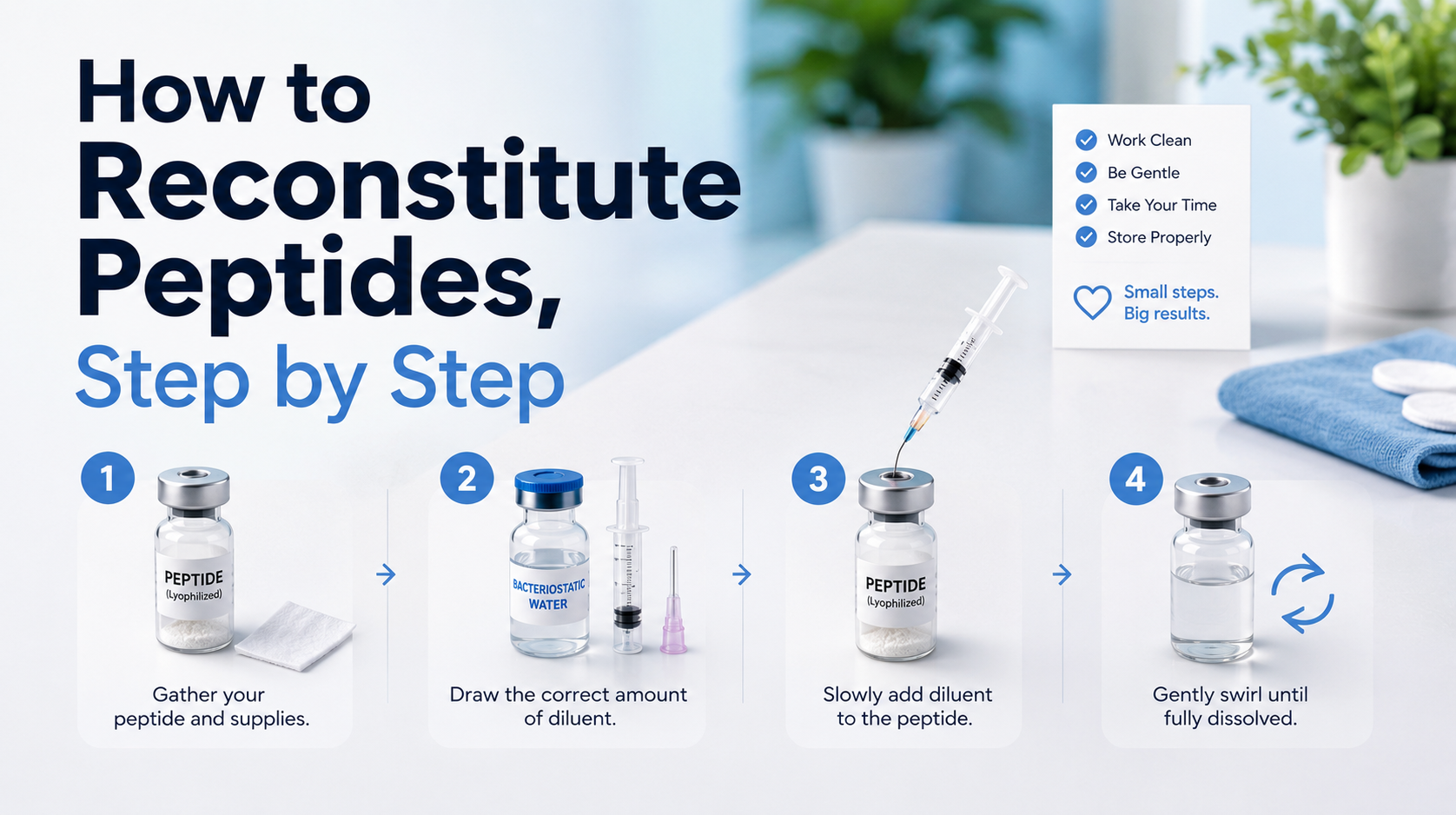
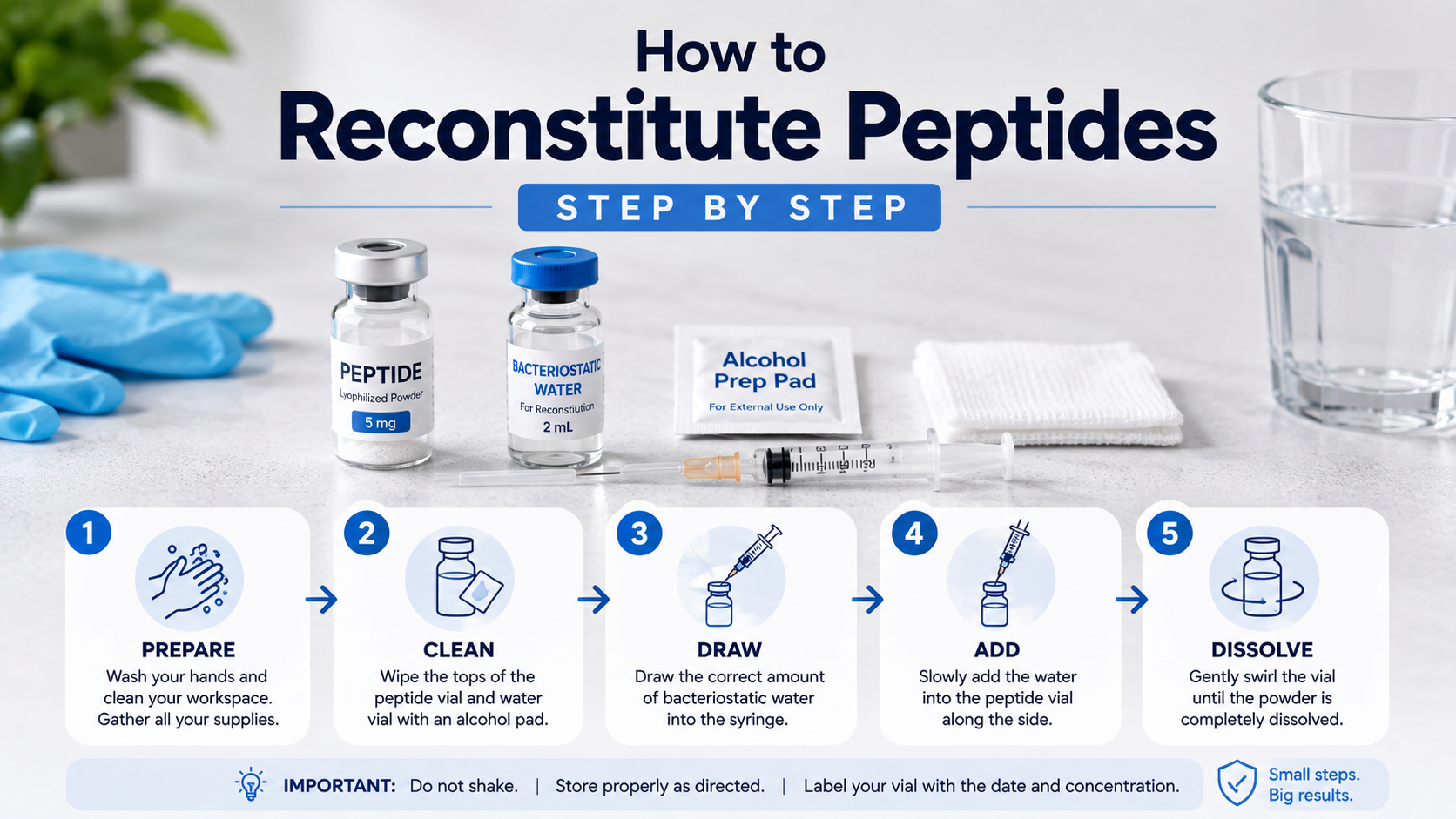
“Reconstitution” means turning the freeze-dried peptide back into a liquid at a known strength, so it can be measured accurately. Here’s generally how that’s done:
- Lay out your materials: the peptide vial, bacteriostatic water, alcohol swabs, and a syringe suited to the volume you’re adding.
- Wipe down before you touch anything: an alcohol swab on the vial top, and a clean surface underneath.
- Figure out your strength: divide the peptide’s weight by the water volume. Mixing a 5 mg vial with 2 mL gives 2.5 mg per mL; stretching it to 5 mL brings that down to 1 mg per mL.
- Draw the water into the syringe, working out any air bubbles before you continue.
- Send it down the glass, not the powder. Aiming the stream at the vial wall instead of straight down keeps the mixture from foaming up.
- Rotate gently until it dissolves. Shaking is too rough for a peptide this delicate and can break it down.
- Confirm the color and clarity: you’re looking for that characteristic pale blue from the copper ion — if it’s cloudy, discolored, or has visible particles, don’t use it.
- Label it on the spot: date, strength, and diluent used.
- Get it into cold, dark storage right away — copper complexes don’t tolerate light or heat well, so this step matters more here than with most peptides.
Storage and Stability
Before mixing: freeze-dried GHK-Cu is generally kept frozen, dry, and away from light until it’s needed — standard practice for peptide research material.
After mixing: once in solution, GHK-Cu is less stable than in freeze-dried form. The copper ion adds a wrinkle other peptides in this series don’t have — copper complexes can be sensitive to light and prone to oxidation over time, so keeping a mixed solution cold, sealed, and away from light matters more than usual. The solution should keep its consistent pale blue color; any obvious shift in color or clarity is a sign it may have degraded.
Avoid repeated freeze-thaw cycles. Each cycle adds some degree of damage. Splitting a solution into smaller portions right after mixing helps avoid this if multiple uses are planned.
Don’t assume it behaves like a copper-free peptide. Stability data for peptides without a bound metal ion doesn’t necessarily transfer to GHK-Cu — treat published shelf-life figures as specific to this compound rather than a general peptide guideline.
Handling Notes
- Using the wrong liquid. Tap water or regular saline isn’t the same as sterile bacteriostatic water, and can introduce contamination or affect stability.
- Shaking instead of swirling. This is one of the most common ways people accidentally damage a peptide during reconstitution.
- Squirting liquid straight onto the powder. This can cause foaming and stress the peptide before it’s even fully dissolved.
- Treating a cell-culture or animal-study amount as a human reference point. Concentrations and doses reported in the literature are scaled to a specific research context — they don’t convert cleanly to a “safe” or “effective” human amount.
- Confusing research-grade peptide with a finished cosmetic formulation. GHK-Cu’s use in skincare products involves specific, tested concentrations in a stabilized formulation — not the same thing as the raw peptide used in a lab study.
- Skipping the certificate of analysis. Always worth checking what’s actually in a batch before using it, particularly for a compound with as much unregulated market activity as GHK-Cu has.
- Not labeling vials clearly. It’s easy to lose track of strength and age without clear notes, especially across multiple batches or studies.
Research Use Disclaimer
GHK-Cu is not approved by the FDA or any other health authority for treating any medical condition. GHK-Cu sold for research purposes is a laboratory research chemical — not a formulated cosmetic product — and is intended strictly for laboratory research use, not for human or animal consumption. Everything in this guide is meant for general educational purposes, based on what’s published in the available research literature. None of it is medical advice, a treatment plan, or instructions for using GHK-Cu on a person or animal.
Using GHK-Cu outside of a legitimate research setting isn’t something we support or recommend — the evidence needed to support a safe, established human dose for the raw research compound simply isn’t there yet.