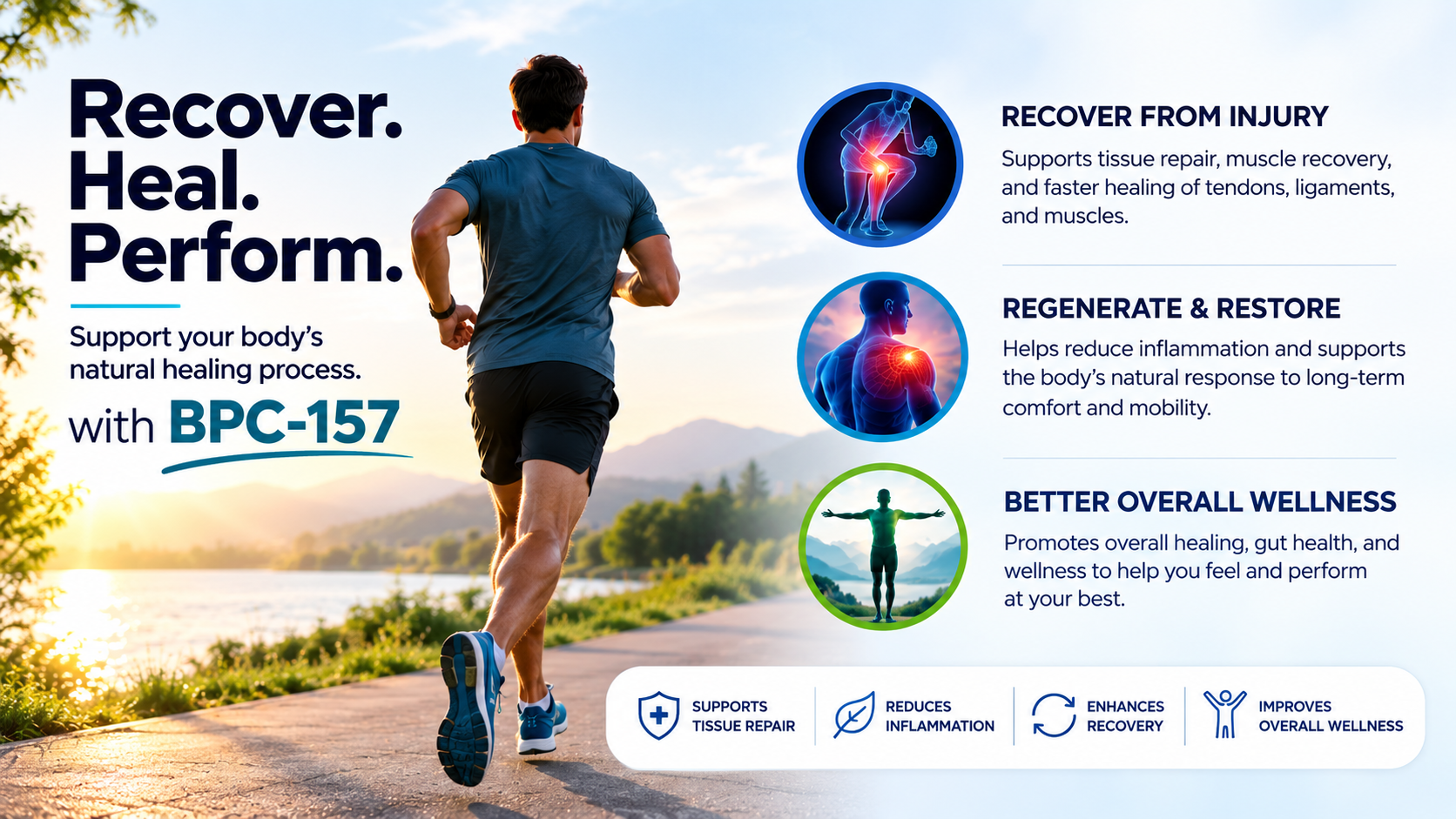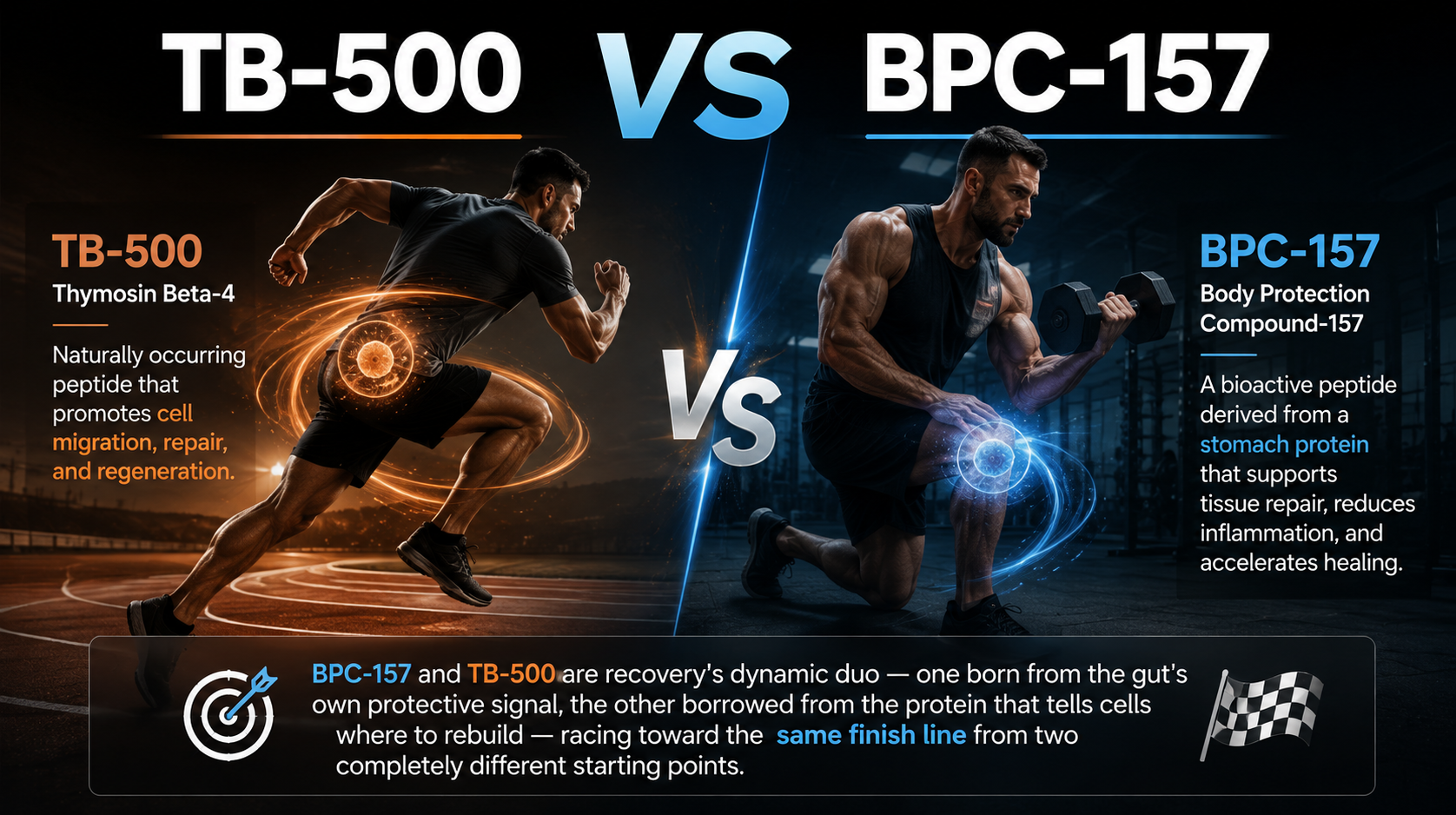
If BPC-157 is the gut-derived peptide that took over recovery research, TB-500 is the one that got there from an entirely different direction — not from digestive science, but from a naturally occurring protein your cells use to move around and rebuild tissue. They end up compared constantly anyway, because they’re chasing the same outcome by different routes, and because the people most interested in one are almost always interested in the other.
This article covers the short answer, how each is thought to work, what recovery research actually examines for each, why they keep showing up together, and a few notes on their research-use forms.
The Short Answer
BPC-157 is a fragment of a protein found in human gastric juice. Its evidence base is almost entirely preclinical — animal and cell studies — plus a small amount of limited human data (one small retrospective study, one Phase I trial).
TB-500 is a synthetic version of an active region of thymosin beta-4, a naturally occurring protein involved in how cells move and rebuild tissue. Some of the clinical wound-healing data often cited for TB-500 — including topical formulations tested for specific wound types — actually comes from broader thymosin beta-4 drug-development research rather than from TB-500 as a distinct compound, so it’s worth treating those two bodies of research as related but separate when weighing the evidence.
Both compounds went in front of the same FDA advisory committee on the same day in July 2026, which voted (non-bindingly) on whether to allow each in compounded prescriptions.
Neither one has been tested directly against the other in a published trial. Every comparison here is built from separate research on each, not a head-to-head study.
How Each Is Thought to Work
BPC-157’s proposed mechanism centers on three overlapping ideas: promoting new blood vessel formation (angiogenesis), protecting cells from damage (cytoprotection — its original context was gut lining protection), and interacting with growth factor pathways involved in tissue repair.
TB-500’s proposed mechanism starts from thymosin beta-4’s natural role regulating actin, a protein involved in how cells move. From there, it’s been studied for its ability to support cell migration, blood vessel formation, and the maturation of stem cells, along with some anti-inflammatory activity.
Here’s the overlap that explains why they’re constantly mentioned together: both compounds are believed to promote angiogenesis, and both are thought to support the kind of cellular activity that speeds up tissue repair — just by different upstream mechanisms. One looks like a protective, regenerative signal borrowed from the gut. The other looks like a repair signal borrowed from how cells physically move and rebuild.
What Recovery Research Examines
BPC-157’s research focus is largely tendon and ligament healing, gut and digestive tract repair, and general wound healing — almost entirely in animal models, with rodent studies making up the bulk of the literature.
TB-500’s research focus is broader in tissue type: preclinical wound-healing work spans skin, cornea, and heart muscle. The “human data” often cited for TB-500 — topical formulations tested for conditions like pressure ulcers and a rare skin disorder called epidermolysis bullosa — actually traces back to broader thymosin beta-4 drug-development programs, rather than to studies on TB-500 itself.
The gap between “what’s been studied” and “what people claim it does” is wide for both. Athletic recovery, general anti-aging, and broad injury prevention are the claims that circulate most in enthusiast circles — and they’re considerably less supported than the narrower, more specific findings in the actual research literature.
Why They Are Studied Together
A few reasons these two keep getting paired:
- They’re chasing the same outcome. Both are associated with faster tissue repair and recovery, even though their proposed mechanisms differ.
- They show up in the same circles. Athletes, fitness communities, and recovery-focused researchers tend to discuss both in the same breath.
- They’re banned for the same reason. The World Anti-Doping Agency prohibits both, on the theory that faster recovery could let athletes train harder and heal faster than would otherwise be possible. TB-500 in particular was at the center of real doping scandals in Australian rugby league and football in the 2010s.
- Neither is approved for human use, and their regulatory paths are moving in parallel. Both BPC-157 and TB-500 were placed on an FDA list of substances too high-risk for pharmacy compounding back in 2023, both were later removed from that list following an announcement from HHS Secretary Robert F. Kennedy Jr. earlier in 2026, and both went in front of the FDA’s Pharmacy Compounding Advisory Committee on the same day — July 24, 2026 — as regulators weigh easing their availability through compounded prescriptions.
Research Use Notes
Both compounds are sold separately as research peptides — freeze-dried material intended for laboratory and preclinical research, not for human or animal use outside of a formal study.
A few things apply to handling either one in a research setting:
- Both are typically supplied freeze-dried and need to be reconstituted with a sterile diluent before use.
- Once mixed, both should be stored cold, away from light, and used within a defined window based on the specific protocol.
- A certificate of analysis (COA) tied to the specific batch — confirming both purity and identity — is the main way to verify what a research sample actually contains.
Blueprint Sciences supplies both BPC-157 and TB-500 with a certificate of analysis for every batch. You can view the current listings here: BPC-157 – Research Use Only and TB-500 – Research Use Only.
Using either compound outside of a legitimate research setting isn’t something we support or recommend.
This article is for general educational purposes only and isn’t medical advice. Neither BPC-157 nor TB-500 is approved by the FDA or any other health authority for any use, and both are banned by the World Anti-Doping Agency for use in competitive sports. Both compounds, when sold for research purposes, are strictly for laboratory research use and are not for human or animal consumption.