Ask around in metabolic research circles which peptide is “better,” and you’ll get strong opinions fast. Semaglutide and tirzepatide are the two biggest names in the field — both already approved as prescription medications, both backed by some of the largest clinical trial programs ever run in this space, and both also sold separately in raw, research-use form for lab work. They share a lot of the same biology. But the one piece they don’t share turns out to matter more than you’d expect.
This article covers the short answer, the mechanism difference between “single” and “dual” agonists, what the research says about each, where each is approved, and a few notes on their separate research-use forms.
The Short Answer
If that’s all you need: semaglutide is the veteran, with years of data behind it and one genuinely surprising finding that had nothing to do with weight loss at all. Tirzepatide showed up later, hits two targets instead of one, and in nearly every trial where researchers put the two head-to-head, it came out ahead.
Semaglutide targets a single hormone receptor (GLP-1). It was the first of this new generation of peptides to become a household name, and it’s the only one of the two backed by a large cardiovascular outcomes trial — not just a weight-loss trial.
Tirzepatide targets two receptors (GLP-1 and GIP). That second target appears to be doing real work: it’s now approved for an additional condition — obstructive sleep apnea — that semaglutide isn’t, and it has generally out-performed semaglutide when the two have been tested directly against each other.
Neither of those approved, prescription versions is what gets sold for lab research, though — more on that distinction at the end.
Single vs. Dual Agonist
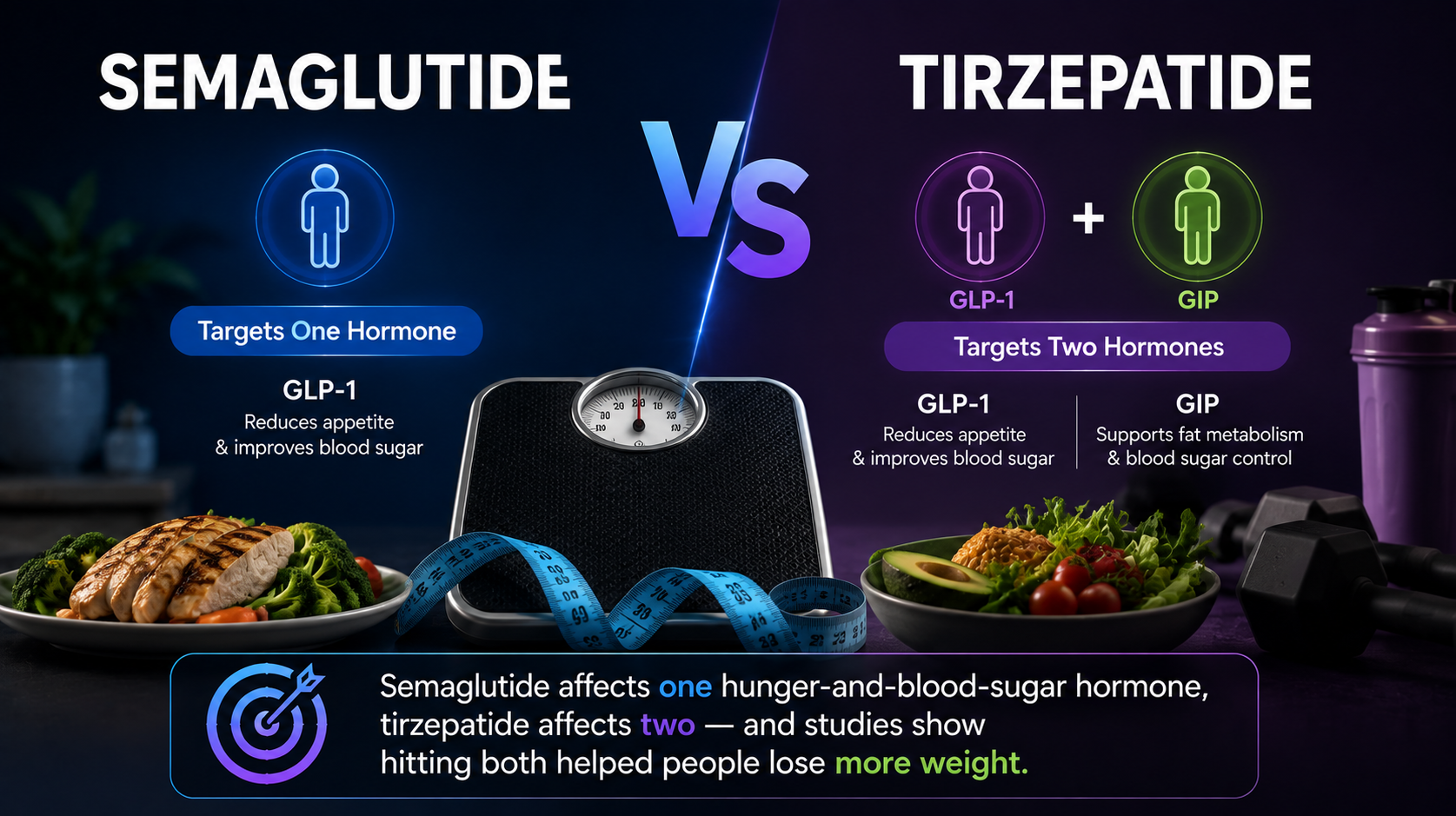
GLP-1 is the pathway both drugs are built on. It slows digestion, increases feelings of fullness, and helps the body release insulin when blood sugar rises. Semaglutide works exclusively through this one receptor — one lever, pulled well.
GIP is the wildcard tirzepatide adds on top. It works alongside GLP-1 to improve how the body responds to insulin, and appears to play its own role in fat metabolism. Tirzepatide actually leans more heavily on the GIP receptor than the GLP-1 receptor, and researchers think that balance is part of why it tends to outperform GLP-1-only options.
Adding a second target sounds like it should obviously help — more pathways, more effect, right? Not necessarily. Plenty of combination approaches in medicine add complexity without adding much benefit. What makes this comparison interesting is that researchers actually tested it directly, rather than leaving it as a theory — and the second lever seems to be pulling its weight.
What Research Examines for Each
Semaglutide’s research story starts with weight loss and ends up somewhere nobody quite expected.
- The STEP program found people on semaglutide lost an average of about 14.9% of body weight at 68 weeks, compared to about 2.4% on placebo — the results that first made the drug famous.
- The SUSTAIN program covered blood sugar control in type 2 diabetes, the condition semaglutide was originally built for.
- Then came the plot twist: the SELECT trial, a large cardiovascular outcomes study, found semaglutide reduced the risk of major cardiac events in people with cardiovascular disease and overweight or obesity. That’s a real benefit showing up independent of the scale — the kind of result that gets a drug taken seriously well beyond its original use case.
- More recent research has pushed into liver disease, where semaglutide is now approved for a form of fatty liver disease with fibrosis.
Tirzepatide’s research story is shorter, but it keeps winning the direct comparisons.
- The SURPASS program found tirzepatide improved blood sugar and body weight in people with type 2 diabetes, generally outperforming comparison treatments.
- The SURMOUNT program focused on weight management, with the highest studied dose (15 mg) producing about 20.9% average weight loss at 72 weeks — noticeably ahead of semaglutide’s headline number.
- This is where the rivalry gets personal: a direct head-to-head trial in type 2 diabetes (SURPASS-2) found tirzepatide produced greater A1C and weight reductions than injectable semaglutide at every dose compared.
- A separate 72-week head-to-head trial in adults with obesity (without diabetes) found the same pattern — tirzepatide produced greater weight loss and larger reductions in waist circumference than semaglutide, though gastrointestinal side effects showed up with both.
Where Each Is Studied
Semaglutide wears three different hats: Ozempic (injectable, for type 2 diabetes), Wegovy (injectable, for weight management and cardiovascular risk reduction), and Rybelsus (an oral tablet, for type 2 diabetes) — a rare feat for a peptide, since most can’t survive being swallowed. It’s also approved for liver disease and continues to be studied for other potential uses.
Tirzepatide wears two: Mounjaro (type 2 diabetes) and Zepbound (weight management, and — as of its newest approval — obstructive sleep apnea in people with obesity).
Neither compound is slowing down. Cardiovascular risk, liver disease, and long-term metabolic outcomes are all active research fronts for both, and it wouldn’t be surprising to see either one picking up new approved uses in the next few years.
Research Use Notes
Here’s the part that’s easy to lose track of in all the head-to-head trial talk: the drugs described above are manufactured, prescribed, and dispensed as specific, quality-controlled products, used under medical supervision. Semaglutide and tirzepatide sold separately as research peptides are different products — same core molecules, but not the approved drug formulations, and not intended for personal or human use.
A few things apply to handling either one in a research setting:
- Both are typically supplied freeze-dried and need to be reconstituted with a sterile diluent before use.
- Once mixed, both are considerably less stable than in freeze-dried form and should be stored cold, away from light, and used within a defined window.
- A certificate of analysis (COA) tied to the specific batch — confirming both purity and identity — is the main way to verify what a research sample actually contains.
Using either compound outside of a legitimate research setting, or in place of the approved prescription products, isn’t something we support or recommend.
This article is for general educational purposes only and isn’t medical advice. Semaglutide and tirzepatide are approved by the FDA under specific brand names for specific indications, when prescribed and dispensed as those approved products. Semaglutide and tirzepatide sold for research purposes are separate, non-prescription products, strictly for laboratory research use, and are not for human or animal consumption.